
Employee Financial Wellness: Reasons Why You Should Care About It

Image (Source)
Do you have productive employees, and if yes, are they satisfied with their jobs? – This is the most common question every business owner will think about, including you!
Nowadays, organizations believe that empowering people empowers profits, so they give as much importance to their employees as they give to their customers. Therefore, they dedicate many resources to the workforce for their physical, mental, and emotional wellness to gain the most out of every process. However, there is another kind that has been overlooked by employers in the past but is becoming more and more important in recent years: financial.
Let’s see what it is and why it is essential in the workplace.
What Is Employee Financial Wellness?
Employee financial well-being refers to your staff’s financial stability and the scarcity of money-related issues. It is a state of being stress-free in monetary terms and managing expenses effectively.
Companies often invest in it to ensure optimum outputs with minimum time and resources spent. This is often done by providing a good ratio of variable pay to employees so they are motivated to make extra efforts for more earnings. Moreover, emergency funds, retirement plans, and loans are additional things to consider.
Usually, employers run financial wellness programs for staff according to their unique necessities and preferences. Some might need money to pay children’s education loans, and some might need timely increments to survive in the era of constantly rising inflation; fulfilling staff’s personalized needs will enhance the employee experience.
The modern-world HR practices also provide education to the workforce for financial literacy and well-being. Mentorship opportunities help the staff in cutting unnecessary personal costs and increase savings. Timely workshops and learning courses assist employees in making essential decisions. In the program, the workforce learns about budgeting, debt management, and return on investments so that they can build a secure future for themselves and their families.
Reasons To Emphasize Employee Financial Wellness
Employees’ financial wellness is a must for employers to achieve the ultimate business goals. It is advantageous for the staff and the organization both. If the employees’ monetary health is fine, then it provides two major benefits:
- Mutual vision – reduced employee churn
- Improved focus – increased productivity
There are various reasons to implement employee financial well-being programs at the workplace. Let’s go through some crucial reasons here:
Improves Employee Productivity
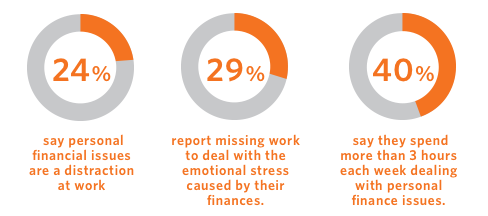
Image (Source)
Employees’ financial health doesn’t only impact their personal life but also their professional ones. Money issues cause a lack of focus at work and distract the workers, affecting the quality of work. In addition, it makes the employees uncomfortable doing their routine tasks, reducing productivity and leading to disasters sometimes.
Monetary wellness programs for the staff give them a sense of having complete control over their finances, allowing them to be productive. When the staff is not worried about money issues while working, it boosts their productivity and improves results.
Helps To Keep Up With The Ever-Changing Employee Expectations
According to a study by LHH, employees’ concerns regarding wellness have increased by 17%, and it was 28% in Gen Z respondents. Gone are the times when the staff was satisfied with the bare minimum and worked at the same place for years to avoid job insecurities. But the time has changed now. Workers need more from their employers and are even ready to discontinue their work if their expectations are not met.
People understand what an organization needs to do for its staff’s well-being, so they expect some care. They want employers to support them in their professional and personal lives. The modern talent force wants to work for companies that invest money in their people’s welfare.
Due to the changing needs of the global workforce and increasing focus on monetary health, you must enable financial wellness programs to sustain the business.
Assists In Building A Robust Employer Brand
In the cut-throat talent war, acquiring suitable candidates for vacant positions is difficult, and you might also find it relatable. Your company needs to be competitive to survive, and for that, you need to create a strong employer brand. The organization’s unique offerings, work culture, employee benefits, and care for the workforce will help you stand out from the crowd.
Financial wellness programs are rarely found in companies, so you can boost the number of applications you receive for a job role by offering them. Millennials and Gen Z feel valued when they are provided financial assistance. So, your staff members can be your brand ambassadors and help you make a strong presence in the talent market.
Reduces Employee Absenteeism
According to SHRM, 9 out of 10 workers come to the office in sick conditions. Therefore, it might increase workplace absenteeism and badly affect business productivity. The main reasons behind workers’ illnesses are money-related, mostly. Because staff often find themselves under a burden of debts, causing them anxiety, heart disease, high/low blood pressure, digestive issues, and many more. This way, monetary issues result in staff absenteeism, and financial well-being initiatives help to solve this.
Another major reason behind staff’s leaves is side business/job after attending the main one. This happens due to poor financial planning, making the employees unable to keep up with the increasing inflation rates. They take another job after work hours for extra earnings, resulting in more leaves due to burnout. The monetary wellness program ensures effective financial planning for the workforce, so they don’t have to look for additional employment.
Increases Employee Retention
The most challenging task for HR professionals is retaining the best talent. Your employees will need a specific reason to stay in business, so you will need to provide them with something unique, and employee wellness initiatives do this work. As mentioned earlier, not all organizations offer monetary wellness initiatives to their staff. You can boost the employees’ job satisfaction by stabilizing their money and increasing their savings.
To retain skilled workers, you will need to create an employee-centric culture and make your employees feel valued & included. In addition, mentorship and guidance about financial management will help the workforce create good wealth in the long run – this will make them hooked to the company and boost their loyalty.
Summarizing
Life is full of difficulties for everyone. But supporting your workforce during their hard times will effectively define your reputation as an employer and enable many other benefits for your business. Implementing financial wellness initiatives can significantly improve employees’ performances, boosting profits. You will not just help them, but you will also contribute to your organization’s success.
In the beginning, you will find plenty of money being invested in the program, but later, you will see a high return on investment. On the other hand, your staff will feel secure, happier, and prepared for future uncertainties.
By going through the above reasons, we can say that the monetary health of employees also matters for the business’s success. So, you must make an efficient program as soon as possible. Firstly, understand what your staff needs and what are the problems they are facing. Then, communicate with them and try to solve their problems. Plan out the program and implement it. Also, ensure it aligns with your organization’s HR strategies.
About the Author

Written by
Ayush Borra
Free Resource
Free tools, templates, and training videos to measure the right metrics and improve your profitability.
Free Consultation
Schedule a free consultation with a profitability expert to find out how much money you're leaving on the table.
Free Consultation
Dr. Jeremy Weisz of Rise25 explains why downloads and subscribers are the wrong scoreboard for a B2B podcast, and how agencies can use guest interviews to build referral partners, strategic partners, and pipeline instead.

About this Episode In this episode of the Agency Profit Podcast, Marcel sits down with entrepreneur and acquisition expert Peter Lang to unpack why mergers and acquisitions may be one of the most underused growth paths for agency owners. Drawing on his experience completing 21 transactions and helping other founders do the same, Peter explains […]

About this Episode In this episode of the Agency Profit Podcast, Marcel sits down with Stephen Woessner, CEO & Founder of Predictive ROI and author/podcaster with 30 years in the industry, to unpack how agencies can win in a low-trust, AI-noisy market by selling with authority. Stephen shares why trust now starts below zero and […]

About this Episode In this episode of the Agency Profit Podcast, Marcel is joined once again by Carson Pierce to unpack one of the most misunderstood topics in agency operations: the relationship between cash flow and profitability. Drawing on real client examples from both ends of the spectrum (profitable but starved for cash vs. unprofitable […]

About this Episode In this episode of the Agency Profit Podcast, Marcel Petitpas is joined by Parakeeto’s consultant Carson Pierce for a candid, behind-the-scenes conversation about one deceptively simple question: what does Parakeeto actually do? Sparked by public feedback on LinkedIn, Marcel and Carson unpack Parakeeto’s evolving positioning as the world’s first profit management firm—and […]

Learn how agencies can build an AI intelligence layer using context-aware agents, automations, and connected data to make smarter decisions and scale efficiently.

About this Episode In this episode of the Agency Profit Podcast, Marcel is joined by M&A expert and Tower Partners principal Todd Taskey to unpack how agency owners can use mergers and acquisitions as a strategic evolution of their business rather than a final exit. Drawing on two decades of deals in the digital marketing […]
.png%3F2026-06-17T10%253A52%253A41.992Z&w=3840&q=75&dpl=dpl_2V79DSWJaJpFdQ2hivFKSM23XLDk)
Carson and Kristen explore why the company is moving away from profitability-focused messaging and toward a clearer promise: helping agency owners by taking care of the money.

AI hasn’t made agency work worse, it has made parts of it replicable. Marcel, Carson and Kristen on what to charge for instead.